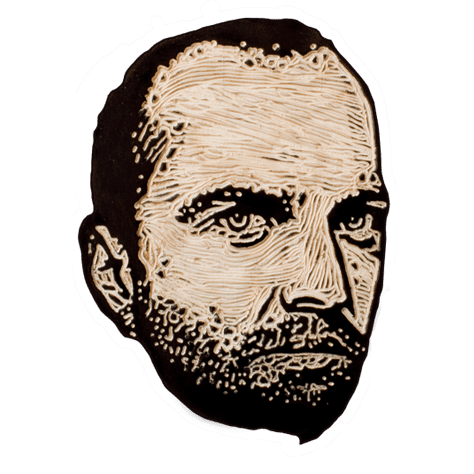

I painted my own face and then I burned it. Then I painted it again. I’ve been doing this for years.
Hollow Man is a self-portrait on wood. Oil paint, a woodburning pen, a knife, and time. The face has been repainted so many times that the person in it has aged through the act of revision alone. Earlier versions bleed through. The eyes darken. The skin thickens. Whoever I was when I started this painting is buried under whoever I become.
The costume was once ornate. I painted it in oil and then burned designs into the surface with a pyro pen, line by line, the smoke went up my nose. Over time the costume deteriorated. The ornament wears down. It’s crumbling. The finery rots.
I carved the bottom of the panel away. Hollowed out the wood. Then I carved a cavity into the chest and embedded a black stone. A real stone. It sits in the chest the way grief sits in the chest. The way a secret does. Heavy, like belief.
The painting is wrapped in black silk. The wooden frame has no glass. The silk absorbs light and sound. The object feels funerary. It should.
The black stone is the shadow given form. The repressed material, the weight you carry, placed at the heart of the self, where it belongs. It is also the blackening that precedes transformation.
For years the painting sat in the studio like a piece of furniture. I worked on it without thinking about why. Then one day I looked at it and saw a stranger. The face that once looked happy had turned monstrous, and it was mine. Now I avoid the eyes. They open onto a place where my life loses its meaning. My self-portrait became a portal to hell.
People ask me when it will be finished. It won’t be.
The unfinished self-portrait is the most accurate self-portrait possible.
About the work
Hollow Man belongs to the series The Ever Evolving Self Portrait.
The face carries every version of itself. Earlier layers surface through later ones, so the features record their own history: young eyes that have aged, smooth skin turned bruised, scraped and pale blue. The background is a sour, unsettling green. Over the years the shoulders have swollen into a heavy, burdened mass. Above the head, a wooden carving bears a Czech blessing: Našemu konání buď Boží požehnání, “May God’s blessing be upon our actions.”
The costume was burned into the paint with a woodburning pen. Its lines are as dense as a Renaissance etching, and every part of the surface is filled, an old horror vacui. That ornament is now wearing away. Finery and ruin share the same skin.
The work crosses from painting into sculpture. The lower panel is carved hollow, and the black stone sits in a real cavity in the chest, with real weight. In Jungian terms the stone is the shadow, everything repressed and unintegrated, placed at the heart of the self. In alchemy it recalls the nigredo, the philosopher’s stone in its crude black state. Earlier states of the painting showed a glow coming from the chest. Darkness and light rise from the same cavity. The wound is also the lantern.
Black silk surrounds the panel like a shroud, and the open wooden frame holds it the way a reliquary holds a relic. The work belongs to the memento mori tradition, with the reminder of death built into the material itself. Each revision is a small death and each return a resurrection. Fire builds the image as much as paint does, in keeping with the Buddhist teaching of impermanence.
Within Milo’s body of work, Hollow Man is the fixed point. The Buddhist Sketchbook is perpetual movement, Elephant Man a ruin of classical antiquity, Love Long Lost a devotional object. Hollow Man is the mirror Milo returns to when he needs to face his own finality.
Writing on Hollow Man
- Hollow Man: A Curatorial Study
The face, the burned costume, the carved body, the black stone and the silk, read one by one. - Hollow Man and the Unfinished Self
An essay on a self-portrait in permanent revision, and the dignity of a figure that keeps enduring. - Portal to Hell: Hollow Man and the Face in the Mirror
How the painting turned into a stranger, read beside research on strange faces in the mirror.


