Hollow Man
MS-003
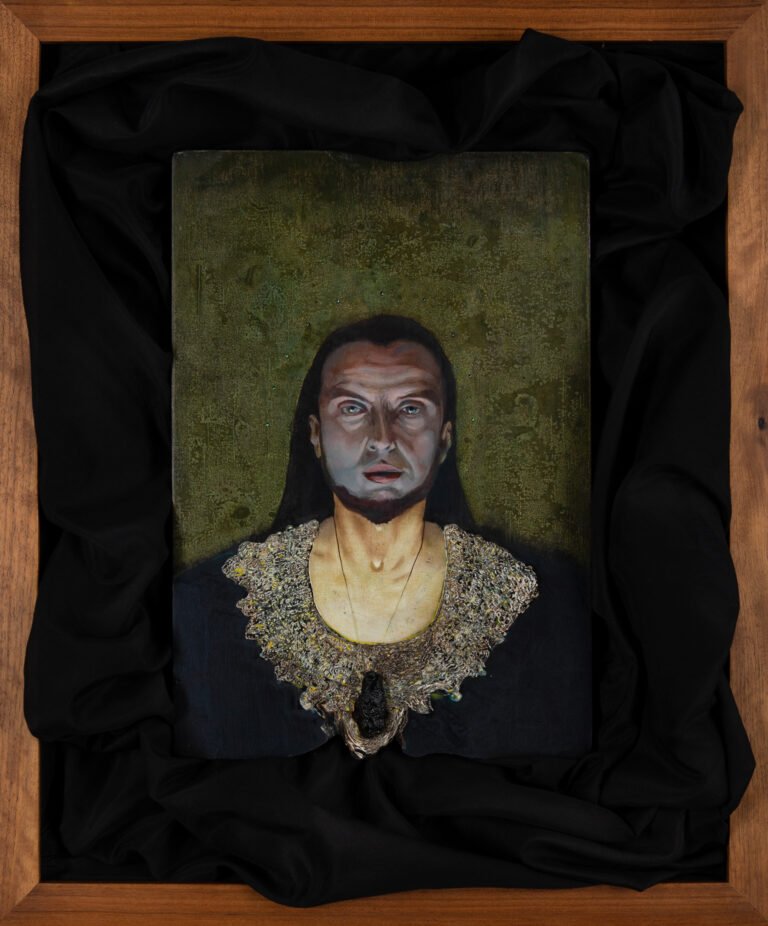
Self-portrait on wood, painted, burned and repainted for years. Oil, pyrography, a carved cavity holding a black stone, wrapped in black silk.
The Disappearing Man is a long-term project built around one vanishing figure. Three works: the ego, the flesh and the myth. A spirit that keeps changing until it completely dissolves.
MS-003
Self-portrait on wood, painted, burned and repainted for years. Oil, pyrography, a carved cavity holding a black stone, wrapped in black silk.
MS-004
There is a man but he is almost gone. Colourless. Carved away and covered, he stands tall, too tall, calm and bewildered. There is … Read

MS-005
The Greeks take their clothes off more than we do. It is the mark of a hero, not about representing the literal world, but … Read
Every person lives behind a face they only meet in reflection. The mirror flips it. The photograph freezes a moment that has already passed. Other people see us from angles we will never reach. Most of the self sits in the dark, behind the eyes, under the skin, in the long shadow of everything we have done and forgotten.
The Disappearing Man follows that hidden self through three works: Hollow Man, Elephant Man and The Disappearing Man. I have been reworking them for about thirty years, since art school. Some began as a scrap of paper with a few smudges, long before there was any concept. I have lost track of when they started. I have no idea when they will end. Each one holds a different layer of the same vanishing figure: the ego, the flesh and the myth.
Hollow Man is a self-portrait, the face the ego shows the world. I painted it on wood, burned it with a pyrography pen, and painted it again, more times than I can count. Each layer covers the one before and lets some of it through. The eyes have darkened. The skin has thickened and bruised. The man in the painting has aged through revision alone.
The ego believes it knows this face. For years I worked on the portrait without really looking. Then one day I saw a stranger. The face that once looked happy had become monstrous, and it was still mine. We live inside our own face, too close to read it.
I carved a cavity into the chest and set a black stone inside. The stone is everything the ego carries and refuses to see. Jung called it the shadow. I wrapped the panel in black silk, like a body prepared for burial. Hollow Man was the first work to carry the title Disappearing Man. The name later passed to another piece, and the idea travelled with it.
Elephant Man is the body after the ego has gone. Its source is a river god from the west pediment of the Parthenon, a marble figure that time had already broken. His head is gone. His arms are gone. I pushed that damage further, cutting and burning the paper along the edges of the body until the figure hung in the void like a fragment pulled from a fire.
In the centre of the torso an enormous eye has opened, a spiral of flesh that pulls the viewer inward. The head once held the ego. With the head gone, the body grows its own eye and looks into itself.
The title points to Joseph Merrick, a man whose body drew crowds and whose inner life went unseen. My figure carries that tension. It is grotesque and tender at once. The skin is bruised and swollen, hardening into stone at the edges. A white cloud rises from its damaged sex: seed, breath, smoke. The flesh keeps producing life as it breaks apart. Desire outlives the form that holds it.
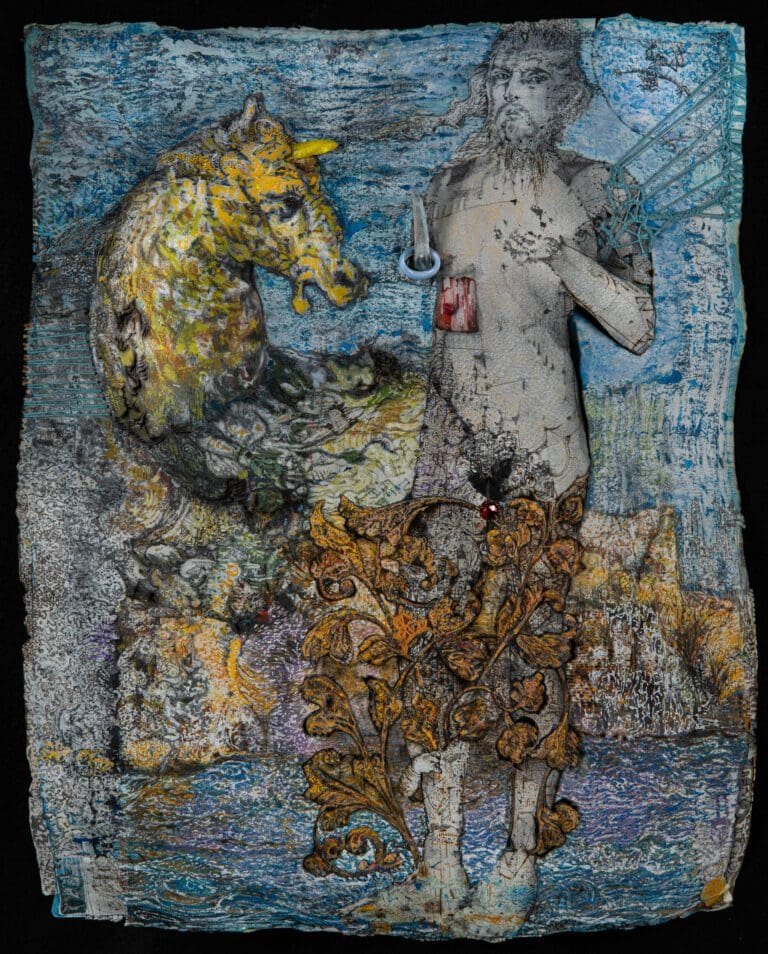
The Disappearing Man is what remains when the person starts to go. A tall pale man stands in water. His head thins into the sky. His feet dissolve below the surface. His heart is exposed. Around him the picture fills with figures from older stories. A small devil hangs above him on strings, pulling him upward while gravity drags him down. A gate opens somewhere behind him, to hell or to a garden. A yellow beast takes shape at his side, a horse with a human eye and a stone in its skull. Behind his burnt leg, a child’s hand grips a vine. I don’t know whose child it is. Maybe the one I was.
One arm has gone, replaced by a crystal. I remember the relief of making it. The flesh was a mess and the crystal was hard. Some part of him would last.
Here the self turns into myth. The private man fades and the symbols take his place: the puppeteer, the beast, the child, the stone. Jung saw figures like these as archetypes, shared by everyone and older than any single life. As the man empties out, the old stories move in. One thing fills the space the other leaves.
The object is dying too. The paper wore through and had to be mounted on a backing, and that backing is now burning and crumbling. Behind it, on the wooden panel, sits an older charcoal drawing that was once a separate work. As the front decays, the back drawing rises into view. One image gives way to another, the way one generation of stories gives way to the next.
Together the three works trace a single spirit through its changes. The ego is the face we try to recognise, the one that grows stranger the longer we look. The flesh is the body that carries us, broken and exposed, still full of desire. The myth is the story we dissolve into, shared and impersonal, holding the shapes of everyone who came before.
My way of working follows the same path. I keep returning to these pieces. I paint over what came before, burn it, carve it, let it rot. Every revision buries a version of the image, the way every year buries a version of the person. The self keeps changing shape behind our backs. By the time we notice who we have become, that person is already leaving.
Buddhism calls this anicca, impermanence. Everything that arises passes away, the self included, and in time the myths as well. In these works the idea becomes physical: soot, torn paper, a stone sitting in a chest.
The final state is nothingness. The Disappearing Man moves toward a point where the figure is gone and only the surface remains. Eventually the surface goes too. I find it hard to look at. Even while drinking tea, I catch it out of the corner of my eye and feel uneasy. It shows me the last part of the self, the part each of us meets alone, at the end.
Until then, I keep working. Each mark adds a layer and takes something away. The man grows thinner. The crystal holds. The beast keeps arriving.